What is spine alignment in a golf shaft?
The spine aligning we do at Value Golf (also sometimes called “spining” - or [inaccurately] “spline” aligning) is a club building procedure to locate a golf shaft's most stable bending plane, usually called the “neutral bending plane” or “natural bending plane”, often abbreviated as NBP. And after locating that stable plane, installing the shaft in a specific orientation relative to the target line for the highest performance. (note that there is another debate I won’t get into here about whether to align the hard spine toward the target or the neutral or natural bend plane toward the target. I do not agree with aligning the hard spine toward the target is the way to go and I think you will understand why if you read on)
Why would aligning a golf shaft a certain way even be necessary? For one, no golf shaft is perfectly round or perfectly uniform in stiffness. Every steel golf shaft for example has a welded seam, and graphite shafts have layers wound around a steel rod or “mandrel” that is removed after the shaft is made. But this process will most often result in a shaft that is not always perfectly round or uniform. A “spine” is similar to a backbone; it’s an axis (a line basically) that is slightly stiffer than the rest of the shaft.
If a shaft is installed randomly, whether it be mass produced clubs on an assembly line, or a careless hobbyist build, the spine could be installed in an improper location and hamper optimal performance.
How do you spine align a golf shaft?
The easiest way to locate the spine of a golf shaft is to use a three bearing based tool similar to this one found at Golfworks. The shaft is put under a load and rotated. The shaft will naturally snap or settle into a specific stable position. This stable axis is often referred to as the Neutral Bend Point or NBP. See the video below for an example of it in action at our shop:
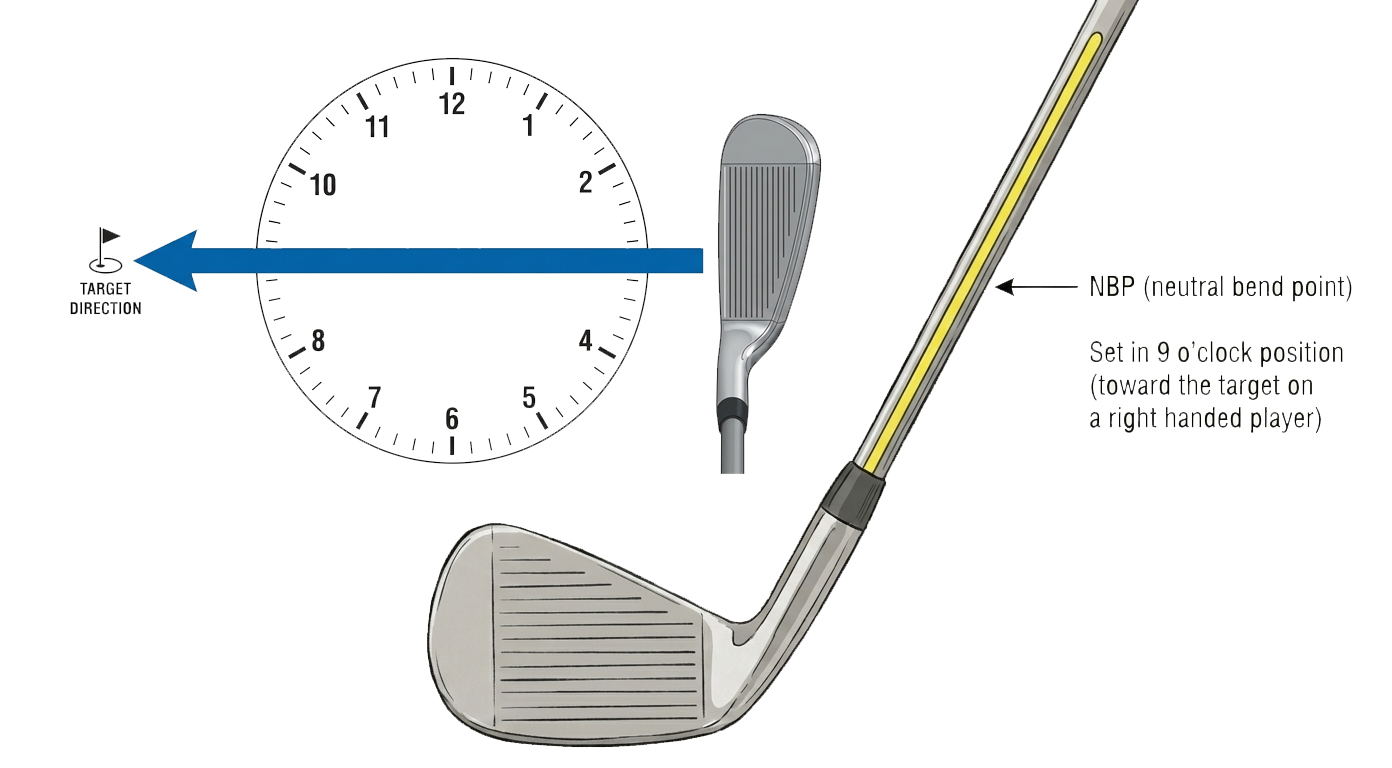
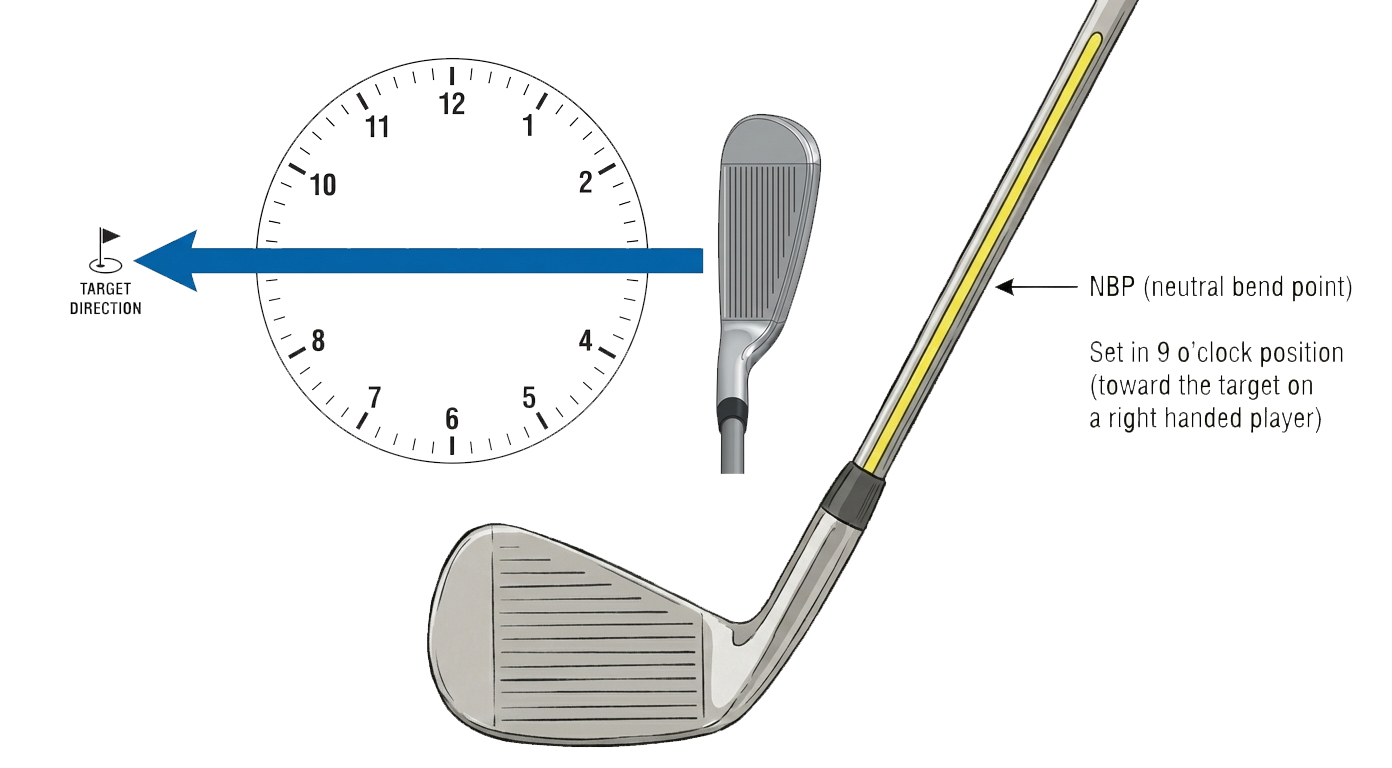
Once the stable plane is found, the shaft is marked and installed in the head so that the Neutral Bend Point aligns with the target line. In other words 9 o'clock for a right handed player or 3 o'clock for a left handed player. Because it’s a “plane” it really can be installed at either 9 o’clock or 3 o’clock for any player, but since we mark the spine aligned component shafts we sell with a sticker with a line on it and explain to point the line toward the target, it’s easiest to just stick with the explanation 9:00 for a right hander and 3 o’clock for a left hander. That way, the line does indeed point toward your target (the fairway, the flag, etc)
What are the real world benefits of spine aligning?
This is where things get controversial. It reminds me of the 90's country song "Politics, Religion, and Her". I'd change it to "Politics, Religion, and Spine Aligning".
The argument against: Some will say that modern manufacturing tolerances, especially from premium brands, are so high that shafts don’t have enough defects for it to make a real world difference. So the argument against aligning is not saying that the shaft would play worse, only that it won’t play better. (see the note below about consistency in flex making this argument moot) After 25+ years here at ValueGolf though, I will say this: I have seen expensive, name brand shafts with a spine so large it would shock you. On the other side of the coin, I have seen inexpensive shafts with very little spine. So that argument does not hold water with me, and I will die on that hill.
The argument for: Having the spine located in the optimal position takes one variable out of the equation. It ensures that the shaft bends and unloads in a straighter line toward the target with less wobbling during the swing. But let’s add one further factor. For argument's sake, let's say the orientation of the spine did NOT help produce a more consistent ball strike. One issue we have not discussed yet is the flex of the shaft. It is universally agreed that the flex of the shaft can be stiffer depending on where the spine is oriented in the club. As an exaggerated example, think of a golf shaft as a yardstick and imagine using that yardstick to hit a golf ball. Aiming the flat side of the yardstick in position to hit the ball is the flex the manufacturer wanted the shaft to be. Turning the yardstick on the side is the harder or less flexible side that is stiffer than the manufacturer intended. Thinking about it in CPM’s or cycles per minute, in one orientation the butt CPM of the shaft may read 240 but if oriented accidentally or randomly right on the spine line, the CPM may read 245. See the below video for a real world example of this:
Do you see the problem here? If you randomly install shafts with a large spine, you can inadvertently have different flexes between 2 different clubs in an iron set or a stiffer shaft than you probably wanted in a wood shaft.
Another argument in the camp that spine aligning and shaft orientation makes a difference is that the USGA themselves deem it illegal to orient a shaft in a location that will manipulate the ball flight to the right or to the left. Why would they bother with this rule if the orientation didn't matter? You can read about the rule at the USGA Website.
To be clear: The USGA does allow aligning a shaft for "uniformity", in other words so the shaft will play as it was intended, but they do not allow installation to be manipulated in order for fix swing flaws.
Bottom line: If spine aligning meant zero, why bother with or enforce a rule at all?
What is FLO'ing a Golf Shaft? Is it different from Spine Aligning?
FLO stands for Flat Line Oscillation. This is a process similar to spine aligning, looking for the most stable orientation of a golf shaft. It usually involves the butt of the shaft being securely clamped so that it does not wobble in any way, and a tip weight with a laser pointer attached to the tip. The builder pulls the tip of the shaft down and releases it to make it oscillate. If the laser moves in an erratic or circular pattern, this indicates the shaft is fighting its natural bend point. If the laser moves in a straight, flat line, this is the FLO plane. The FLO plane would then be installed to the target (9 o'clock for a RH player).
What is SST PURE or PURE'ing a Golf shaft?
SST PURE’ing is a premium shaft alignment process. SST PURE stands for Strategic Shaft Technologies Plan of Uniform Recovery. It requires a specialized machine that uses sensors to measure the shafts structure around the circumference of the shaft. The machine finds what they call the “Neutral Axis”. Pundits would argue that the process is no more beneficial than spine alignment or FLO’ing, and it costs upwards of $50 per shaft done. Ooof.
What is residual bend?
When we speak of spining a steel shaft, what we are really doing is finding what some clubmakers refer to as residual bend in the shaft. Whatever you call it, residual bend, residual stress, a spine, etc., there is probably variation in the wall thickness of the steel shaft. (clubmakers often still refer to it as finding ‘the spine’ or NBP). In any case, there is stiffness asymmetry there. Whether finding the residual bend (or neutral bend plane) in a steel shaft is important or ‘worth it’ is another subject hotly debated. See what I said above about flex variation. This also applies to a steel shaft, and to me, getting the flex uniform in a set of irons is ‘worth it’.
Other Real World Applications of Spine Aligning
Spine Aligning is not just just a golf shaft thing. It has similar benefits in the fishing world. Fishing poles are a similar concept and design as a golf shaft, and they also have spines. In something as intricate as fly fishing, you want to cast that fly in the perfect location to catch that brown trout, and some fishermen will cover every variable to have their equipment perform it's best.
Archery is another example. A skilled bow hunter will often take the time to spine align their arrows (often made with carbon fiber like golf shafts) so that they can fly perfectly straight. Small variables can mean hitting the target or missing out on that 12 point buck.
Is there any DISADVANTAGE to Spine Alignment?
There is one - aesthetics. For steel shafts where you would apply the label after the club has been built, it's not an issue. Simply build the club properly with the NBP or FLO line in the correct location and affix the labels after the fact however you wish. But for steel shafts with permanent labels or for graphite shafts, if you assembled them with the proper orientation, its likely that the graphics will line up completely at random. If you are very meticulous, this could be an issue. It's completely personal preference. Most of our customers know this is how they will look and still prefer the performance benefit of aligning a shaft properly. But if this is a deal breaker for you personally and you don't want to do it for aesthetic reasons, who are we to judge?
So what is the bottom line about Spine Alignment?
The TL;DR version: Almost every shaft has a spine, steel or graphite. No shaft is perfectly round or uniformly stiff. It's debated hotly, but it is our take that it can make a performance difference, particularly to keep flex uniform throughout a set, and also to keep a shaft on the proper plane. The results can be subtle, but probably the most important question to ask yourself: Why not do it?